Lash glue, temperature and humidity
Why the humidity level and the temperature of your room decide how long extensions last, explained the way we teach it, with the reason behind every setting.
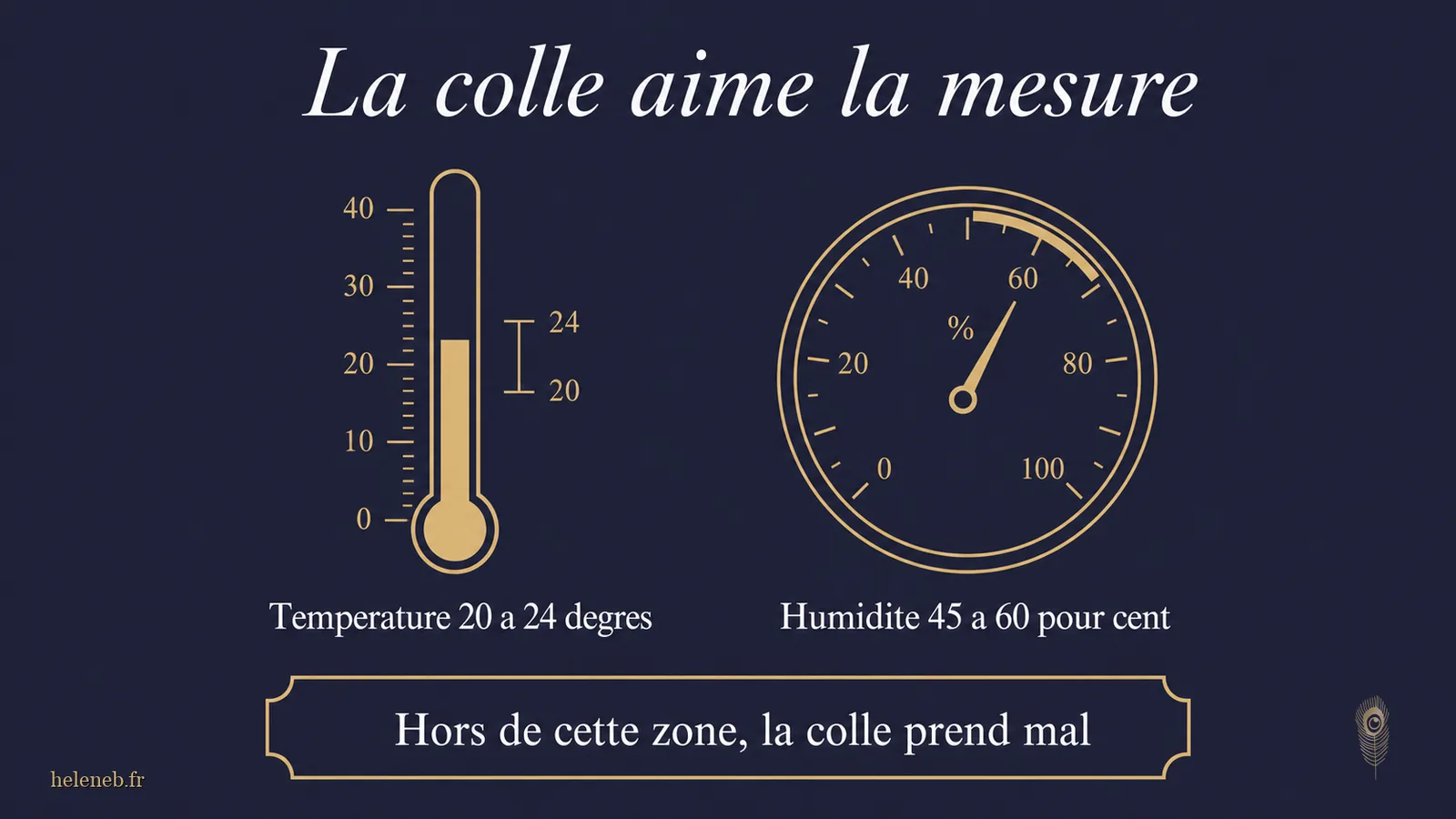
You apply as usual, your gesture is clean, your glue is new, and yet a client comes back with a fringe that gave out far too early. You doubt your glue. You doubt yourself. What if I told you that, nine times out of ten, it is neither one nor the other? It is the air of the room where you work.
- Lash glue hardens thanks to the humidity in the air, not thanks to time passing. It is a cyanoacrylate glue, it polymerises on contact with water molecules.
- Humidity controls the cure speed. Too dry, it grips poorly. Too humid, it sets too fast and snaps clean.
- Temperature acts in the same direction. The warmer it is, the more fluid and fast the glue becomes. The colder it is, the more it thickens and slows down.
Your glue is rarely the problem, the air of your room often is
Lash glue is not a glue like the one in a DIY tube. It follows a precise chemistry, and that chemistry reacts to two things you cannot see but that your client then wears for weeks, the humidity level and the temperature.
Understanding this means you stop playing the lottery with retention. The same glue, the same technician, the same gesture do not give the same hold depending on the air of the room. Here is the reason, explained the way we teach it.
The glue cures with water from the air, not with time
Lash extension glue is a cyanoacrylate glue. Its particularity, it does not dry by losing a solvent, like paint. It polymerises: its small molecules link to one another to form a solid chain, and what triggers this chain reaction is the humidity present in the air.
Keep the image, the glue needs the water molecules in the air as a match. Without enough humidity, the reaction starts badly. With too much humidity, it races away. Concretely, the cure of your glue does not depend only on your gesture, but on the air around your gesture. Two identical sets in two different rooms do not give the same hold, and no glue brand can correct that for you.
Humidity, the slider that decides the cure speed
Humidity is the technical word for the level of moisture in the air, expressed as a percentage. It is what sets the speed at which your glue cures.
Air too dry. Moisture is missing, so the match barely catches. The glue cures slowly, sometimes too slowly. The concrete consequence, while you place the next extension, the previous one has not finished making its bond. The glue dot stays soft too long, the final adhesion is weak, and the fringe gives out earlier than expected.
Air too humid. The opposite. There is so much water in the air that the reaction races away. The glue sets almost instantly, sometimes even before you have placed the extension in the right spot. And a glue that sets too fast turns white, hardens on the surface and becomes brittle. You get a glue dot that is hard but fragile, which breaks at the first rub of the pillow. This is the famous shock cure, a bond that looks solid but is brittle.
Air stable and suited to your glue. There, everything goes well. The cure is steady, you have the right timing to place each extension, the bond forms completely and stays supple. It is in this zone that your retention is at its best.
The trainer angle to remember, you do not fail a set because you are bad. You fail it because your glue did not have the right conditions to do its job. That can be measured and corrected.
Temperature, the second slider, the one we forget
The temperature of the room also plays a part, and in the same spirit.
Warm room. Heat makes the glue more fluid and speeds up the reaction. It runs more, it sets faster. If on top of that the air is humid, the two effects add up and you end up with a glue that slips through your fingers.
Cold room. Cold thickens the glue and slows the cure. It becomes pasty, harder to dose, and the bond takes longer to form. A glue taken out of a cold place just before the appointment is a glue that does not behave as it should.
What matters most is not having a precise temperature to the degree, it is having a stable temperature throughout the whole appointment. Why? Because a set takes a long time. If the room warms up over the hours, the behaviour of your glue changes along the way, your timing from the start no longer works at the end. A temperature that does not move gives you a predictable cure time, and a predictable cure time is a gesture you control.
“The same glue, the same technician, the same gesture do not give the same hold depending on the air of the room.
Cure time, the visible consequence of the two sliders
Cure time is the delay between the moment you place the extension and the moment the glue has fixed it. It is the direct consequence of humidity and temperature combined.
Why must you know it for your precise glue? Because it controls your application pace. If your glue sets in one second, you do not have time to correct a placement, you have to be right the first time. If it sets in several seconds, you have a margin to adjust, but you must wait before releasing the extension, otherwise it moves.
When the air changes, the cure time changes, and your usual pace no longer fits. This is exactly what happens when a technician loses her touch without understanding why, it is not her who changed, it is her air. She keeps applying at the winter pace while it is the middle of summer.
Why your sets hold less well in summer, and what to do
Now you have all the pieces to understand the great classic, my sets last less in summer. In summer, two things rise at the same time, heat and humidity. Both speed up the glue. As a result, it sets too fast, makes brittle shock cures, and retention drops, sometimes by half. Without you having changed anything in your gesture or your glue.
The false good idea is to switch glue every season. The real solution is to take back control of the air. You do not control the weather outside, but you control your work room. Measure, then stabilise, that is the whole point.
Take back control of your air, the right reflexes
Here is the logic, the reason behind each gesture rather than a list of equipment.
Measure first. A thermo-hygrometer placed near your worktop shows you the temperature and humidity continuously. Without it, you apply blind. With it, you know whether you are in your glue's zone or not, even before you start. It is the most profitable tool in the trade, and one of the cheapest.
Lower the humidity when it rises. A dehumidifier removes water from the air of the room. You use it when your hygrometer climbs above what your glue likes, typically on stormy days or in the middle of summer. The aim is not to dry out, it is to bring the air back into the steady zone.
Raise the humidity when it is missing. Conversely, in winter, heating dries out the air and your glue can set too slowly. A humidifier, or a nano-mister used at the end of the set, can help the glue finish its cure. The nano-mister projects an ultra fine water mist that brings moisture right where it is needed, at the right moment.
Stabilise the temperature. A room that does not yo-yo between morning and afternoon is a glue that behaves the same all day long. Avoid applying next to a window in full sun or a radiator that switches on and off.
Take care of your glue itself. A glue well stored, well shaken, at the right temperature and not expired is the basis even before talking about air. A fresh drop replaced regularly during the set always reacts better than a drop that has dried in the open air.
Why lash glue reacts to the air
- The principle
- cyanoacrylate, polymerises with humidity
- Humidity too low
- slow cure, weak bond, holds less
- Humidity too high
- shock cure, brittle glue, holds less
- The right reflex
- measure, then stabilise the air
Getting trained, why this setting cannot be improvised
You can read an article like this one and understand the logic. But knowing, on your own glue, in your own room, which humidity to aim for, how to react on a stormy day, how to adapt your application pace when the air changes, that is passed on and corrected in real time.
Everything above is not chemist's theory. It is what decides whether your client leaves with a fringe that holds its three to four weeks, until the refill, or with a set that crumbles after ten days. And retention is your reputation. A disappointed client does not say it was too humid in the room, she says it does not hold, it is poorly applied.
Beyond the setting, there is all the rest, the first clients, the retention that worries, the Tuesday evening doubt when a set has given out and you do not know why. That is where the promise of the house takes on its meaning. Independent, yes. Alone, never. Getting trained also means having someone to turn to when the air, the glue or the gesture raise questions.

Hélène B
Trained within a world-renowned international brand. 13 years of experience in lash extensions, including 10 years as a trainer, and more than 500 technicians trained in France and abroad.
Want to steer your retention, not endure it?
Our lash extension trainings, with trainer support and a community of technicians. Independent, yes. Alone, never.
Discover the trainings