Why a set does not last
Do your extensions only last two weeks? In the vast majority of cases, it is an application problem, not a product problem. Here are the 6 retention mistakes, and the move that fixes each one.
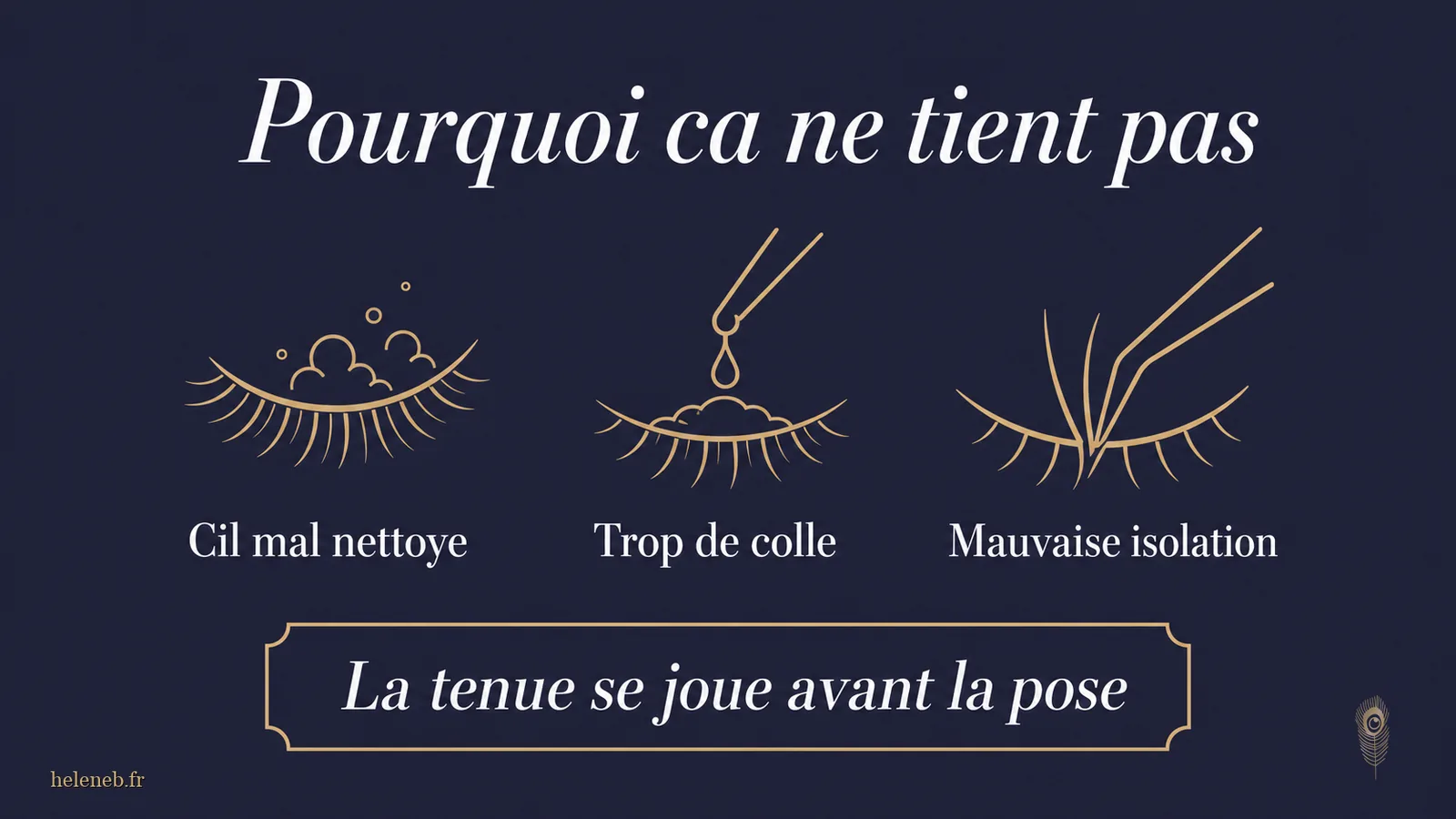
You apply the set, it looks lovely, your client leaves happy. And ten, twelve, fourteen days later the message arrives, "I have almost nothing left." If this has already happened to you, you are not alone, and above all you are not bad at this. Retention is the topic that comes up the most in training, because it is where everything really plays out. First thing to know, and it is a relief, losing a few extensions a day is perfectly normal. A natural lash lives, grows, then sheds, and it takes its extension with it.
- If extensions only last two weeks, it is almost always an application problem, not a product one.
- Retention depends on the bonding surface between the extension and the natural lash, and on how the glue cured.
- A well-done set follows the lash rhythm, you plan a refill roughly every 3 weeks.
Two weeks is too short, and it does not have to be that way
Losing a few extensions a day is normal, the natural lash sheds and takes its extension with it. That is why you plan a refill roughly every 3 weeks. But losing most of the set within two weeks is not the lash cycle. It is a signal. And in the vast majority of cases, the problem comes from the application, not the product. We are going to go through the 6 mistakes that wreck retention, one by one. For each one, you will understand why it makes lashes fall, because it is by understanding the cause that you fix the move for good.
Mistake n°1: a base that is too thick, the false good idea
This is the king of mistakes, the one seen the most in beginners. When you are afraid it will not hold, the reflex is to add more glue. Logical, except it is exactly the opposite of what you should do.
The why: how long an extension lasts does not depend on the amount of glue, it depends on the quality of the bond. A successful base is a thin film that coats the natural lash and the extension over a short length, and fuses them cleanly. A base that is too loaded forms a big drop that hardens into a rigid ball. And a ball cracks. The slightest rubbing, the slightest brush stroke, and the contact point gives way in one piece. On top of that, a thick base is heavy, and weighing the lash down makes it fall sooner. You think you are reinforcing, you are actually weakening.
What we teach instead, dip the extension in a measured way, lay down just what is needed, and aim for a smooth base, almost invisible. A good base cannot be seen and cannot be caught with a fingernail, it can barely be felt.
"How long it lasts does not depend on the amount of glue, it depends on the quality of the bond.
Mistake n°2: poor isolation, the cascade of pulled lashes
Isolation is the move of separating a single natural lash from all its neighbours before placing the extension on it. When it is done badly, two natural lashes end up glued together by the extension.
The why: each natural lash has its own cycle, it grows and sheds at its own pace. If the extension links two lashes, the day the first one wants to shed, it pulls on the second one that had asked for nothing. The result, both rip out together, sometimes before they even reach the end of their life. It hurts the client, it creates gaps in the lash line, and retention collapses. Worse, chronically poor isolation eventually weakens the natural lashes for good.
This is precisely the kind of move you cannot pick up from reading. You need an eye on your hand, in real time, to tell you "there you caught two lashes, start over." That is what we correct in training, model after model.
Mistake n°3: wrong glue dosage, too much or too little
We said it about the base, but dosage deserves its own point, because each extreme creates a different problem.
The why of too much: excess glue takes longer to cure all the way through. On the outside it looks dry, but inside the drop stays soft. It often goes white too (glue that cured badly turns a milky white). A bond that never truly hardened does not hold, it lets go after a few days.
The why of too little: without enough glue, there is simply not enough contact surface between the extension and the lash. The extension is placed, it looks fine in the moment, but it is barely bonded. It comes off at the first face wash.
The right dosage is an in-between that you work on through practice, until the move becomes a reflex.
Mistake n°4: a poorly prepped natural lash, the glue does not grip
Before you even place anything, there is a step that rushed beginners skimp on, cleaning the natural lash.
The why: a natural lash is naturally coated in a film of sebum, and often in leftover makeup, cream or mascara from the client. Lash glue needs to grip onto a clean, dry surface. On an oily film, it slides, it does not adhere properly, and the bond is weak from the very first second. You can have the best move in the world, if the surface is greasy, it will not hold.
Hence the dedicated cleanser at the start of the session, which degreases the lash and removes any residue. Those are five minutes that change the retention of the whole set. Skipping this step is sabotaging your own work before you have started.
Mistake n°5: humidity, the invisible ally that is misunderstood
Here is a point many beginners overlook, and it explains sets that hold very well one day and badly the next, without changing a single thing about the move.
The why: lash extension glue is a cyanoacrylate glue, it cures thanks to the humidity present in the air. It is counter-intuitive, but it is not dry air that sets the glue, it is a correct humidity level. If the air is too dry, the glue cures slowly and badly. If the air is too humid, it sets too fast, sometimes before you have even placed the extension, and the bond becomes brittle. In both cases, retention suffers.
That is why a serious technician monitors the humidity of her workstation and adjusts. Understanding this parameter is how you tell the difference between "my technique is bad" and "the application conditions were not good." Often it is the second one.
Mistake n°6: client aftercare, the retention that plays out after she leaves
You can do a flawless set, if your client does not know how to look after it, she will come back saying it did not last. And technically she will be right, except the cause was not in your move.
The why: the glue needs to finish curing after the application. During that window, water, the steam from a hot shower, the sauna or the steam room can disturb the set and lift extensions that are still fresh. Then, over time, three enemies keep coming back, rubbing (rubbing the eyes, sleeping with the face crushed into the pillow), classic mascara that clogs the base, and above all oil-based makeup remover, which literally dissolves the glue.
That is why a good set always comes with clear aftercare advice, given to the client before she leaves. A technician who takes two minutes to explain this gets called back far less often about sets that "did not last." Taking care of the after is protecting your work and your reputation.
| Mistake | What happens physically | The effect on how long it lasts |
|---|---|---|
| Base too thick | The glue forms a rigid ball instead of a fine bond | The contact point cracks at the slightest rubbing |
| Poor isolation | The extension links two natural lashes | One lash pulls on the other and they rip out together, gaps in the line |
| Too much glue | The drop does not cure to the core, it turns white | A soft bond that lets go within a few days |
| Not enough glue | Insufficient contact surface | The barely bonded extension comes off at the first cleanse |
| Lash poorly cleaned | A film of sebum, makeup, oil on the lash | The glue slides and does not adhere, weak bond from the start |
| Wrong air humidity | The glue cures too slowly or too fast | Badly formed or brittle bond |
| Neglected client aftercare | Water, rubbing, mascara, oil-based remover | Extensions lifted or dissolved after the application |
And if you are a beginner, do not confuse normal shedding with poor retention
One last marker, because it reassures a lot of students. Losing extensions every day does not mean your set failed. The natural lash grows and sheds constantly, that is life, and the extension goes with it. That is why the refill happens roughly every 3 weeks. What should alert you is not the steady loss, it is the massive, rapid loss. If a set collapses within ten or fifteen days, go back over the list of 6 mistakes, one of them is almost always to blame. The good news is that they can all be fixed. None of them is a question of talent, they are moves that are learned and adjusted through practice.
Normal retention or warning signal
- Daily shedding
- a few lashes a day, normal
- Refill rhythm
- every 3 weeks (4 at most)
- Set collapsing in 2 weeks
- a signal, one of the 6 mistakes at fault
- Most frequent cause
- the glue base
Training: retention gets fixed with an eye on your hands
You can read this article and understand the 6 causes. But knowing that your base is too thick and feeling the right amount of glue under your fingers are two different things. Isolation, dosage, reading the humidity, all get corrected in real time, with someone watching your hand and telling you "there, too much glue" or "there, you caught two lashes." It is exactly this moment that turns a hesitant technician into a technician whose sets last.
And after the training, when the real question comes up ("my retention dropped this week, I do not understand"), it is precious not to be alone when looking for why. That is the whole meaning of the promise, Independent, yes. Alone, never. Training is also having someone to turn to the day a set resists you.

Hélène B
Trained within a world-renowned international brand. 13 years of experience in lash extensions, including 10 years as a trainer, and more than 500 technicians trained in France and abroad.
Fix your retention, the trainer's eye on your hands
Our classic and Russian volume trainings, with trainer support that watches your hand and corrects you in real time. Independent, yes. Alone, never.
Discover the trainings