The weight rule, what a lash can really carry
A natural lash only bears a limited load: the equivalent of one 0.15 mm extension, or about 6 fibres of 0.07 mm. No more. Here is the rule that the whole of Russian volume is built on, and what happens when you break it.
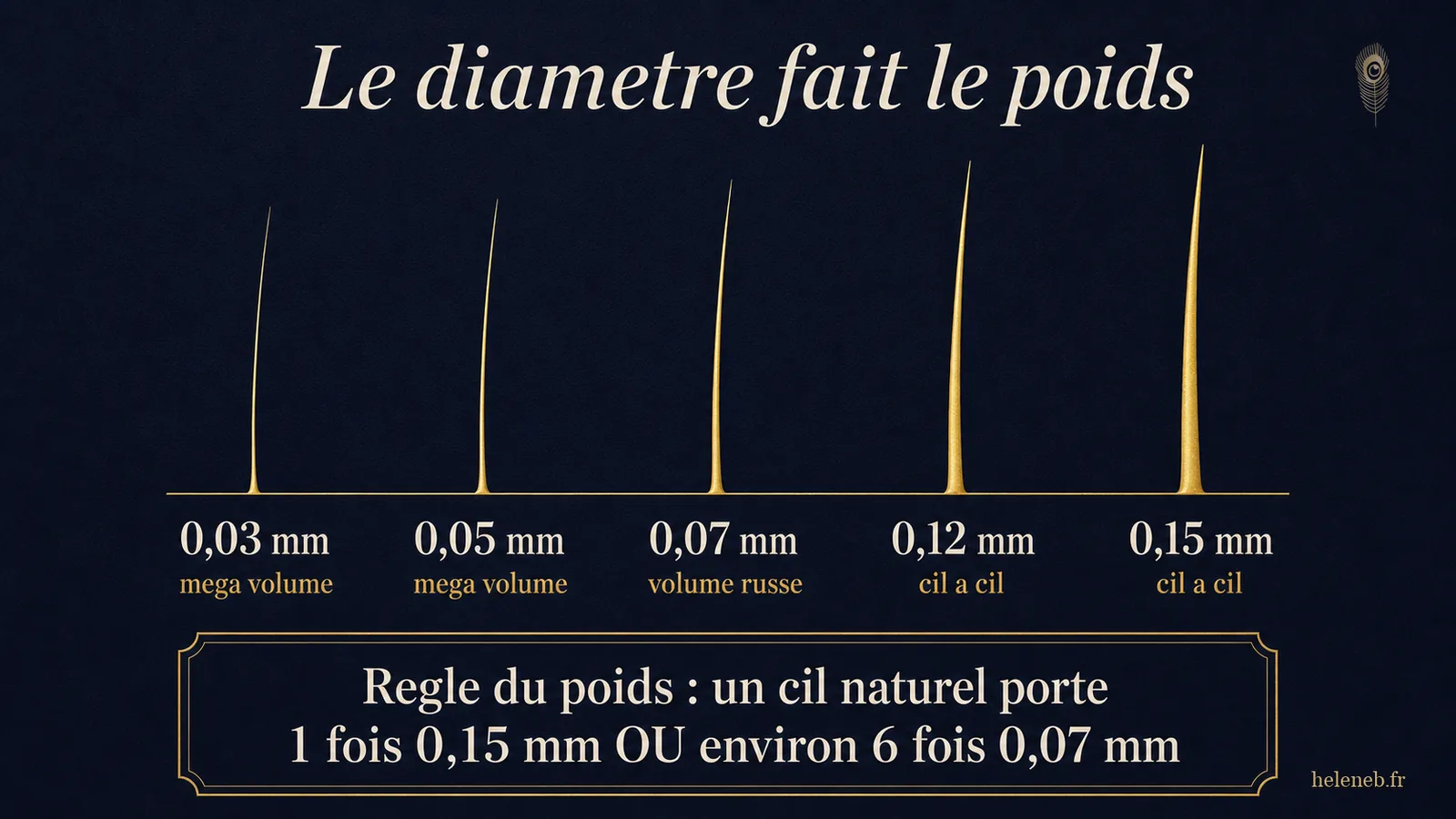
If there is only one thing to remember about Russian volume, it is this. A natural lash cannot carry just anything. It has a limit, and that limit fits in one sentence: it bears the equivalent of one 0.15 mm extension, or about 6 fibres of 0.07 mm. It sounds almost too simple put that way. But when a student truly understands this rule, everything else falls into place.
- A natural lash carries the equivalent of ONE 0.15 mm extension, OR about 6 fibres of 0.07 mm. No more.
- This is the entire logic of Russian volume: you build a fan of very fine fibres (0.07 mm), 2 to 6 per fan at most, without exceeding that weight. In 0.10 mm, which is thicker, you limit yourself to 2 fibres (the 2D).
- When you cross that threshold, the natural lash is overloaded. It weakens, falls early, and the line gets gaps.
The sentence I repeat most in training
If there is only one thing to remember about Russian volume, it is this. A natural lash cannot carry just anything. It has a limit, and that limit fits in one sentence: it bears the equivalent of one 0.15 mm extension, or about 6 fibres of 0.07 mm.
It sounds almost too simple put that way. But when a student truly understands this rule, everything else falls into place. The choice of diameter, the number of fibres per fan, the reason Russian volume even exists rather than thick classic everywhere. It all starts here.
And when you do not understand it, the opposite happens. You place pretty, well filled fans, the client leaves delighted, and three weeks later she comes back with gaps in the line and the feeling that she has damaged her lashes. So let us look together at why this rule exists, and what happens when you break it.
A natural lash is a fine shaft planted in a living root
Before we talk about weight, you have to see what is in front of you. A natural lash is not a solid hook. It is a fine, flexible shaft, anchored in a follicle, exactly like a hair. It grows, it lives for a few weeks, then it falls and a new one grows back. It is a permanent cycle.
As long as that lash is healthy, it can carry a load. But a reasonable load. If you attach something too heavy to it, two things happen. In the short term, the lash bends, it points the wrong way, the result is distorted. In the longer term, and this is the real problem, the root is pulled constantly. The follicle tires, and the lash ends up letting go before its time.
Why this matters to know: because the whole craft is about enhancing without damaging. A set that lasts two weeks instead of three and weakens the lash is not a good set, even if it looks lovely in today's photo. The weight rule is the numerical translation of this principle: you respect the lash so the result lasts and leaves no damage behind.
The rule, plainly: 1 times 0.15 mm, or about 6 times 0.07 mm
Here is the trade reference, the way we teach it. A natural lash carries the equivalent of ONE 0.15 mm extension, OR about 6 fibres of 0.07 mm.
Read the "or" carefully. It is an equivalence, not an addition. Either you place one 0.15 mm extension, or you spread that same permitted weight across several finer fibres. In both cases the lash bears the same total load. What changes is the look.
And that is exactly the reason Russian volume exists. If the lash carries about 6 fibres of 0.07 mm, then I can build a fan of several fine fibres, open it nicely, and get density, without ever exceeding what a single thick extension would have weighed. Russian volume is not "more weight". It is the same permitted weight, broken into several fibres to create visual volume. That is the magic trick, and it is entirely physical.
Russian volume does not weigh the lash down
- Permitted load
- 1 times 0.15 mm
- Equivalence
- ≈ 6 fibres of 0.07 mm
- Russian volume
- same weight, broken up
- Condition
- respect the limit
Why fibres are so fine in volume: it all flows from the rule
When you start out, you often wonder why Russian volume uses 0.07 mm while classic goes up to 0.12, 0.15, sometimes 0.20 mm. The answer is in the weight rule, and it is logical.
In classic, you place one single extension per lash. Since there is only one, it can be thicker: 0.12 or 0.15 mm most of the time, up to 0.20 mm on very thick natural lashes. The lash only carries one, the count works out.
In Russian volume, you place several fibres on the same lash. If I want to put 4, 5 or 6 of them, they have to be much finer, otherwise the total exceeds what the lash can bear. Hence the standard 0.07 mm. For mega volume sets, where you raise the number of fibres per fan even further, you go down to 0.03 or 0.05 mm. The more fibres you want, the lighter each fibre has to be. It is weight arithmetic, nothing else.
That is also why 0.10 mm, which is thicker, is limited to 2 fibres per lash, what we call the 2D. Two fibres of 0.10 mm and you land right on the limit. Adding a third would push past the threshold. The weight rule, again and always, dictates the number of fibres according to the diameter.
| Fibre diameter | Fibres per fan | Why |
|---|---|---|
| 0.07 mm (standard Russian volume) | 2 to 6 fibres at most | fine fibre, you can spread several under the threshold |
| 0.10 mm (thicker) | 2 fibres only (the 2D) | heavier, two fibres are enough to reach the limit |
| 0.03 / 0.05 mm (mega volume) | more fibres, ultra fine | tiny fibres to multiply density without overload |
What really happens when you break the rule
This is where the trainer's angle matters most, because it is the mistake I see most often in self taught technicians.
A technician wants a very full result. She tells herself that a fan of 8 or 10 fibres is prettier, denser, more "wow". In the moment, it works. The set is spectacular, the client loves it.
Except that fan weighs too much for the natural lash carrying it. And here is the chain, step by step, because understanding the concrete consequence changes everything. The natural lash is pulled constantly by a load it was not made to carry. Its root tires, the follicle is taxed beyond its normal cycle. As a result, the lash falls before its time, when it should have lasted another week or two. Since it takes the fan with it, several fibres are suddenly missing in the same spot. That is what creates those gaps in the line that clients describe, and that impression that "extensions damage the lashes".
The trap is that it is not the glue, nor the brand, nor the client rubbing her eyes. It is almost always a dosing problem. A fan that is too heavy, placed against a lash too fine to carry it. The weight rule was not respected, and the lash paid for it.
“The real craft is saying no to the overly dense fan when the lash cannot follow.
Why I say "break" the rule and not "forget" it. Because we almost always know it. The temptation of the pretty, in the moment, is stronger than the physical limit. It is less flattering in the photo. It is infinitely more respectful of the client's eyes over time.
Dosing a fan is not reciting a number
You might think it is enough to remember "2 to 6 fibres" and you are done. If only.
The truth is that not all the natural lashes on the same eye have the same strength. The lashes in the outer corner are often finer and more fragile. A client with sparse lashes does not carry as much as a client with thick, dense lashes. The right dosing is not a fixed number, it is a reading. You look at the lash under your tweezers, you assess what it can carry, and you adapt the fan to it, not the other way around.
This is precisely what cannot be learned alone in front of a screen. You can understand the weight rule by reading this article, that is the whole point. But adjusting a fan to a real lash, sensing when it is overloaded, correcting the gesture in real time, that is passed on eye on your hand, in training. Theory gives you the rule. Guided practice gives you the judgement.
Respecting the weight rule is not a constraint that holds back your creativity either. It is what makes your work durable, healthy, and recommended. A technician whose sets last and do not leave gappy lashes is a client who comes back and talks about you to those around her. Russian volume already gives you enormous freedom of result, from a barely densified look to very dense, simply by playing with the number of fibres and the curls, within the weight limit.
What I want you to remember
Russian volume is not "heavier" than classic. It is the same permitted weight on the lash, spread differently to create density. All the subtlety of the craft lies in respecting this limit: 1 times 0.15 mm, or about 6 fibres of 0.07 mm.
Once you have that in your hand, you never place a fan at random again. You place it for the lash in front of you. And that is built with a trainer and a group you can put your questions to, not by searching for the answer alone at 10 p.m. Independent, yes. Alone, never.

Hélène B
Trained within a world-renowned international brand. 13 years of experience in lash extensions, including 10 years as a trainer, and more than 500 technicians trained in France and abroad.
Learn to dose your fans, not to recite them
The weight rule is understood by reading. Adjusting a fan to a real lash is passed on eye on your hand, in training. Independent, yes. Alone, never.
Discover the trainings