Russian volume 2D 3D 4D, the numbers that feel scary
2D, 3D, 4D, sometimes 5D or 6D. An avalanche of numbers that seems reserved for pros. The truth is, it reads like a recipe. Here is what these labels mean, and why you cannot do just anything with them.
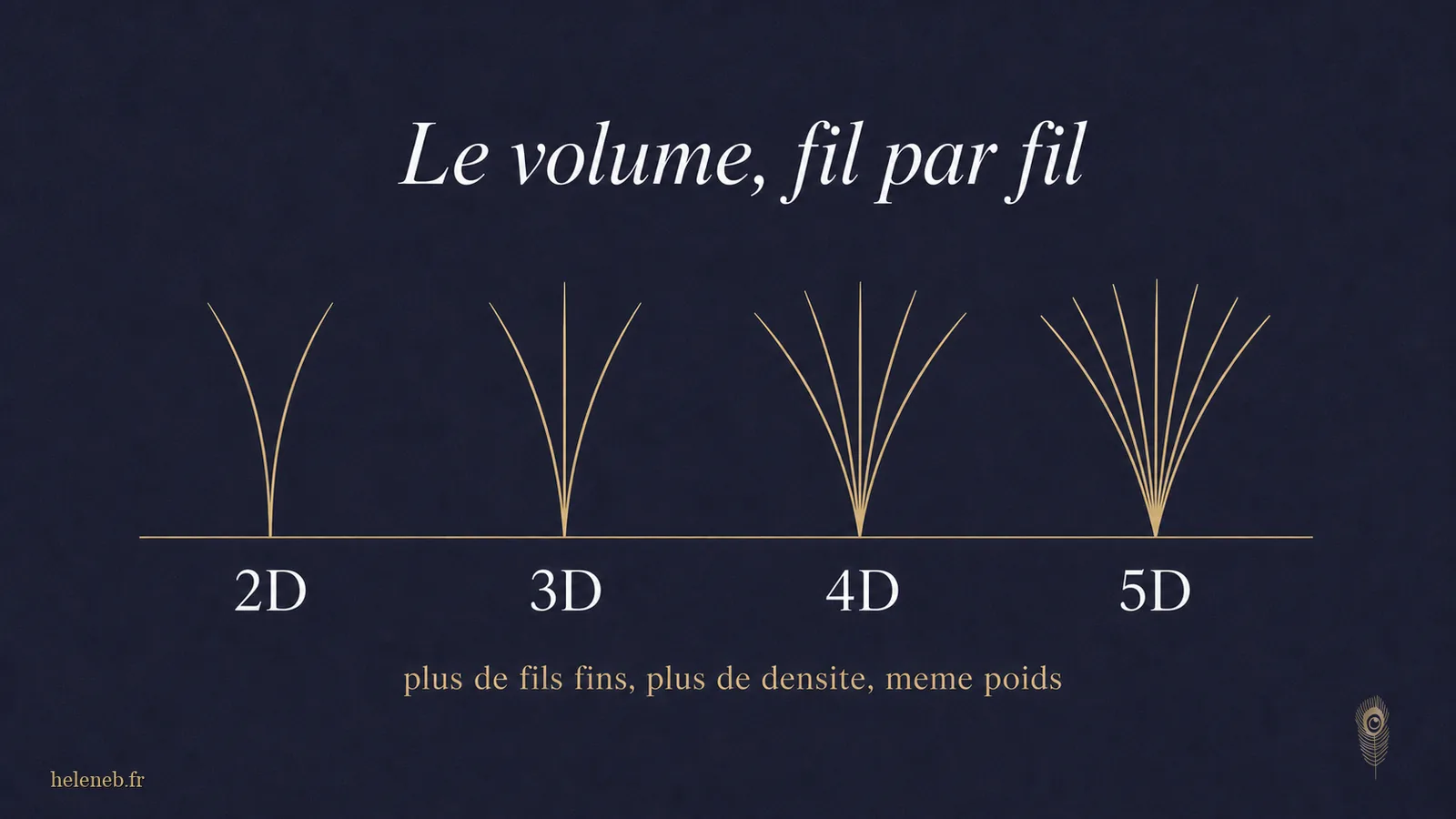
When you start looking into Russian volume, you quickly run into an avalanche of numbers. 2D, 3D, 4D, sometimes 5D or 6D. You see them in Instagram photos, in training names, on product sheets. And you tell yourself it must be complicated, reserved for pros who already know everything. The good news is that it is much simpler than it looks. Once you understand what the D stands for, you read these numbers like a recipe.
- The number followed by a D tells you how many fibres are in a single fan, placed on a single natural lash. 2D, 3D, 4D means 2, 3, 4 fibres.
- The higher the D, the denser the look. But that number depends on the diameter of the fibres and on what the natural lash can carry.
- A lash carries the equivalent of one 0.15 mm extension or about 6 fibres of 0.07 mm. A clean 2D is often done in 0.10 mm, while 3D and 4D move to 0.07 mm.
The D means dimension, but above all remember a number of fibres
The D in 2D, 3D, 4D comes from the idea of dimension, of volume. But forget the fancy word. In practice, here is what it concretely means. In 2D, you place a fan of 2 fibres on a natural lash. In 3D, a fan of 3 fibres. In 4D, a fan of 4 fibres. In 5D, 6D and beyond, 5 fibres, 6 fibres, and so on. Always on a single natural lash. That is what sets Russian volume apart from classic, where you place one extension per lash. In volume, you build a small fan by hand, close its base, and place the whole cluster on the root of a natural lash.
So when a client asks you to give her a 3D set, she is asking you, without knowing it, for fans of 3 fibres each. Nothing more mysterious than that.
Why the number of fibres changes the look
The more fibres you put in a fan, the more you fill the empty spaces between the natural lashes. That is the density effect. Picture a slightly sparse fringe of natural lashes, with gaps. A 2D will gently flesh it out, the result stays readable, you can still see well drawn lashes. A 4D, on the other hand, fills in far more, the look becomes dark, full, more dramatic. A 5D or 6D gives that very glamorous, very dense effect you see on spectacular sets.
But beware the shortcut. More fibres does not mean prettier, it means denser. On a client who wants a natural look, a 4D will be too much. On a client who wants intensity, a 2D will be disappointing. The right volume is the one that matches the request and the condition of the lashes, not the highest number.
The real subject, the weight the lash can carry
This is the heart of the craft, and the reason these numbers are not chosen lightly. A natural lash is fragile. It only carries a limited load, otherwise it bends, weakens, and ends up falling before its time. The rule every technician must keep in mind is simple: a natural lash carries the equivalent of one 0.15 mm extension, or about 6 fibres of 0.07 mm.
You can see where I am going. If you have room for about 6 fibres of 0.07 mm in total, then a 4D in 0.07 mm stays within the margin. A 6D in 0.07 mm reaches the limit. Beyond that, or with thicker fibres, you go over, and you weaken the lash. That is why diameter and number of fibres always go together. You never reason about the number of fibres alone, you reason about the total weight of the fan.
Why 2D is often done in 0.10 mm, and the rest in 0.07 mm
This is the angle I really want you to remember, because this is where many beginners go wrong. In Russian volume, the standard diameter is 0.07 mm. It is a fine fibre, designed so you can stack several without weighing the lash down. For mega volume sets, where you go very high in number of fibres, you go even finer, to 0.05 mm or even 0.03 mm, precisely to offset the quantity.
The 2D, however, is often an exception. With only 2 fibres, you have margin on the weight. So you can afford a thicker fibre, 0.10 mm, and it is often even a better choice. Why? Because with 2 fine fibres of 0.07 mm, the result sometimes lacks presence, you make the effort of building the fan without really gaining density. Two slightly thicker fibres in 0.10 mm give a sharper, more visible 2D, while staying well under the weight threshold since there are only 2 fibres.
The general logic is easy to remember: the fewer fibres you use, the thicker a fibre you can afford. The more fibres you use, the finer each fibre must be. It is always the same balance, total weight above all.
“Dosing a fan is not reciting a number. It is protecting your client's lash capital.
The golden rule of volume
- The weight threshold
- A natural lash carries the equivalent of one 0.15 mm extension or about 6 fibres of 0.07 mm. It is this rule, and this rule alone, that sets how many fibres you are allowed to place.
- The fibre to diameter balance
- Fewer fibres allow a thicker fibre (2D in 0.10 mm). More fibres require a finer fibre (3D, 4D and beyond in 0.07 mm).
- The real danger
- A fan that is too heavy weakens the natural lash, the lash falls prematurely, and gaps appear in the fringe.
- Choosing a volume
- It is not picking a number from a menu, it is calculating whether the fan you are building will stay under the threshold.
How to read a set in practice
Now that you have the keys, you can decode any set. When you read Russian volume 3D in 0.07, you know how to read it: fans of 3 fibres, 0.07 mm fibre, so a perfectly reasonable weight, a denser but not extreme look. When you read 2D in 0.10, you know we are going for a sharp, present 2D, with a thicker than average fibre, and that it holds because there are only 2 fibres. When you see mixed 3D 4D, you understand the number of fibres was varied across the zones of the eye, denser towards the outer corner for example, to shape the look.
That is what reading volume means. Not reciting labels, but understanding what they imply for the look and for the health of the lash. One question always comes back, both from future technicians and from clients: is doing a 4D much longer than a 2D? A little, yes, because you have to pick up and open more fibres per fan. But most of the application time comes from the building itself, the act of making the fan, not so much from the number of fibres in it. To give honest benchmarks, a beginner takes up to 4 hours on a Russian volume set, the time needed to acquire the fan technique. An expert completes a handmade cluster set in 1 h 30 to 2 h. Beyond 4 hours, I prefer to split the session rather than force it, because visual fatigue costs you precision, and a fan poorly closed when you are exhausted is a fan that holds badly. Maintenance follows the same rhythm whatever the density, a refill roughly every 3 weeks keeps a dense fringe, because that is the natural cycle of lash growth and shedding.
Training, why you do not learn the fan alone
You can understand all the theory of 2D, 3D, 4D by reading this article. That is even the goal, that it be clear. But building a fan that is even, symmetrical, closed at the base, placing it without sticking the natural lashes together, and above all sensing whether the weight is right, that cannot be read, it is corrected in real time, with an eye on your gesture.
That is exactly the moment when a trainer changes everything. When your 3D opens into a fan that is too wide, when you stick two lashes without noticing, when you do not dare go up to 4D for fear of damaging, you need someone beside you who sees, corrects, reassures. And after training, there is real life. The first client who asks for a volume you have never done, the technical question that pops up on a Tuesday at 9 pm, the doubt you do not dare to voice. That is where the promise takes on its full meaning. Independent, yes. Alone, never.

Hélène B
Trained within a world-renowned international brand. 13 years of experience in lash extensions, including 10 years as a trainer, and more than 500 technicians trained in France and abroad.
Master the fan, from 2D to mega volume
Our Russian volume trainings, the gesture taught step by step, with the support of a trainer and a community that moves forward with you. Independent, yes. Alone, never.
Discover the trainings